Sometimes it's easy to feel like we live in a cold, dark world where people don't care about voting, when you are begging and they don't seem to understand what's at stake or how hard people have fought for that right.
For those moments, I wanted to share two stories of people who went above and beyond to make sure their vote counted in this historic election, both of which left me in tears. (Although to be fair I cried watching Brave so...) My spirit is more than renewed to chase down my own absentee ballot on Monday.
First a man who was about to plead guilty to a felony and, realizing he might be about to lose the right to do so forever, asked the judge if he could vote first. I will save my soapbox about the vast racist conspiracy that disenfranchises felons for another time. Read his story with tissues unless you have an iron heart.
And second, well I'll just tell you the title, "The Last Thing My Mother Did Before She Died Was Vote for Hillary Clinton" and can I say hat tip to women's magazines like Glamour and Cosmo that have been covering more and more of these type of stories that affect women's lives.
Brb. Sobbing.
Campaign Love and Mine,
Nancy
Showing posts with label voting rights. Show all posts
Saturday, October 29, 2016
Thursday, September 4, 2014
NAACP v. Husted
Despite what the picture on his website might have you believe, Ohio Secretary of State Jon Husted REEEEAAALLLLY doesn't want more people voting. Like really, really. You may remember some of his greatest hits like getting sued by OFA and getting hauled in front of a judge for deliberately disobeying the court's order to restore early voting. The ACLU brief sums it up nicely.
"In Ohio, targeting early voting has become a pattern. In 2011, the Ohio General Assembly passed a law eliminating both Golden Week and the last three days of early voting before Election Day. Voters responded by organizing a ballot referendum to strike down the law, prompting legislators to repeal it on their own.May of this year rolled around and Husted and his bros in the legislature were like, "You know what we should do? Cut early voting. That's gone awesomely and been totally legal before." Enter NAACP v. Husted.
In 2012, Husted continued the pattern by issuing a directive that cut the same three days of early voting for all non-military voters. The Obama campaign responded with a federal lawsuit and the court forced Husted to restore the early voting days, allowing an additional 67,000 voters to cast an in-person ballot before the election."
"The lawsuit names Husted and Ohio Attorney General Mike DeWine as defendants. It seeks to strike down Ohio Senate Bill 238, a 2014 law that eliminated the first week of early voting in Ohio. This period, often referred to as "Golden Week," enables voters to register and cast a ballot on the same day. The suit is also challenging a 2014 Husted directive that further slashed the early voting period by eliminating all Sundays, the Monday before Election Day and all evening voting hours."Thankfully, and unsurprisingly, a Federal court granted injunctive relief this morning ruling that the law violates Section 2 of the Voting Rights Act(the part prohibiting laws that have a racially discriminatory effect) which means Golden Week (weird name) will be restored for the midterms. Can Ohio please stop now?
Labels:
court,
Early Voting,
NAACP,
Ohio,
racist,
Voter Suppression,
voting rights,
Voting Rights Act
Wednesday, July 16, 2014
Update: Voting Rights Amendment Act of 2014
When I wrote about the Supreme Court's decision to strip Section 5 of the Voting Rights Act Shelby County v. Holder last year, I noted that preclearance could return if Congress could approve a more updated formula that reflected modern mechanisms and history of voter suppression. As you may remember, Section 5 required that certain jurisdictions have any changes in voting laws "precleared" by the Department of Justice or a three-judge panel in DC. Section 4 outlined the criteria under which states and municipalities were subject to Section 5. Shelby v. Holder struck down Section 5 under the assertion that the formula in Section 4 was outdated and unfairly treated some states differently than others. Preclearance was one of the most important facets of the Voting Rights Act because it shifted the burden of proof from disenfranchised citizens on to the states and jurisdictions that disenfranchise them.
A year after the landmark (and deeply upsetting) decision, voting rights advocates led by Democrat (and Batman enthusiast) Senator Patrick Leahy are working to revise the formula in order to restore the teeth to the VRA. S.1945 or the Voting Rights Amendment Act of 2014 amends the criteria for which states and jurisdictions that would be covered under Section 5. You can read the details here, but the gist is that the formula would include states and municipalities with a substantial history of voting rights violations over the course of the previous 15 years.
Unsurprisingly, like almost everything else good that could possibly happen in Congress, the bill is stalled in the house.
For more Section 5 on CampaignSick click here and here.
Labels:
SCOTUS,
Voter Suppression,
voting rights,
Voting Rights Act
Sunday, November 3, 2013
Today In Voter Suppression: North Carolina 12-Year Old Is My New Hero
A 12 year old from North Carolina SCHOOLS legislators on voting rights. I don't have much to add here except, I'm glad she's on our side.
Tuesday, May 21, 2013
New York May Become the First City to Allow Non-Citizens To Vote

Talking Points Memo:
If the City Council passes the proposal, New York would be, by far, the largest city in the nation that allows non-citizens to vote. Non-citizen voting currently exists in multiple smaller municipalities in Maryland and Massachusetts. The locations that have passed immigrant voting in Massachusetts have been unable to implement it because they need state approval. According to Ron Hayduk, an author, professor at Queens College, and co-founder of the New York Coalition To Expand Voting Rights, who was part of the team that helped advise on the creation of the bill, contends that, as a charter city, New York would not need approval from the state. However, Hayduk acknowledged there is some dispute on that issue, which he said will be debated at a joint hearing conducted Thursday by the Council’s committees on immigration and governmental operations.
I am fascinated by this! What do we think?
Sunday, May 12, 2013
This is What Voter Fraud Actually Looks Like
Via The Voting News
Prosecutors are investigating allegations of voter fraud in Little Armenia, part of a Los Angeles City Council district where two candidates are waging a bitter battle for an open seat. According to a spokeswoman for L.A. County Dist. Atty. Jackie Lacey, prosecutors are trying to determine whether backers of one candidate illegally filled out mail-in ballots for dozens of voters in the Armenian enclave in East Hollywood. The May 21 election will decide who succeeds Eric Garcetti, who is running for mayor. In a complaint sent to Lacey’s office, an attorney for candidate John Choi accused backers of Choi’s opponent, Mitch O’Farrell, of “widespread voter fraud and illegal electioneering activities.”
The complaint alleges that O’Farrell campaign workers filled out voters’ ballots for their candidate while telling them they were voting for Sam Kbushyan, a candidate of Armenian descent who ran and lost during the primary election.
Kbushyan and many of his former campaign volunteers are now working on behalf of O’Farrell.
The O’Farrell campaign rebuts the allegations, saying it was Choi workers who filled out and took ballots from voters. “These are Choi people who are doing this,” O’Farrell spokeswoman Renee Nahum said.
Nahum said the campaign plans to file its own complaint with the district attorney that will include testimony from voters who said they gave their ballots to Choi campaign workers who claimed that they were representing Kbushyan.
Saturday, February 9, 2013
Elections Performance Index!!!
If there are two things I am passionate about they are election reform and interactive infographics. So I just about squealed over the Pew Charitable Trust's Election Initiative's Elections Performance Index when it was released earlier this week.
The EPI measures states's overall election administration performance based on 17 criteria: Absentee Ballots Rejected, Provisional Ballots Rejected, Absentee Ballots Unreturned, Registration or Absentee Ballot Problems, Data Completeness, Registrations Rejected, Disability- or Illness-Related Voting Problems, Turnout, Military and Overseas Ballots Rejected, Voter Registration Rate, Military and Overseas Ballots Unreturned, Voting Information Look-Up Tools Available, Online Registration Available, Voting Technology Accuracy, Post-election Audit Required, Voting Wait Time and Provisional Ballots Cast.
The data is illuminating. For instance, did you know that 3% of (non-provisional or absentee) ballots in West Virginia don't get counted? Ruh Roh. But it's poor old Mississippi at the very bottom of the list. They really need to be first in something good and soon. Wisconsin is at the top of the pack. There are a lot of really sexy infographics to choose from, but I am linking to this interactive graph that lets you sort states by any combination of criteria, shows which criteria were most important in each state and ahh well...it's just divine. I will let you check it out for yourself. Click around the rest of the report too.
Charles Stewart III, an MIT Political Science Professor whose research created the basis for the EPI analyzed some of his findings in this interview.
"States with election-day registration have more people registered to vote … [and] people in those states are less likely to say that they had registration problems that kept them from voting. Jurisdictions that have electronic voting machines tend to have longer lines than those with optical scanners."
Enjoy! I'm going to go back to nerding out.
Today In Voter Suppression: Voter ID Debate Still Goin' Strong
When I presented my Op-Ed on Section 5 to my Policy Writing class one of my classmates responded, "I kind of thought all of this was resolved when Obama won re-election." Lest I catch any of you making similarly ill-informed statements, here are just a few of the things going on with Voter ID laws across our great country:
Virginia: Senate Bill 719 and House Bill 1337, which passed the Senate and House of Delegates on largely party line votes, will severely restrict the number of acceptable forms of voter identification. The laws will take effect in 2014.
Maine: An independent panel formed by a Republican official and charged with examining Maine's electoral system has concluded that the state should not a implement voter ID system. "The issue of voter ID became a hot topic in Maine in November, when outgoing Republican Party Chair Charlie Webster claimed that part of the reason Republicans lost their races was because black voters cast ballots in rural Maine towns...Webster later apologized."
Indiana: Under proposed House Bill 1311, students who pay out-of-state tuition would not be able to vote in Indiana.
Missouri: "The Missouri House is set to again consider legislation that would require voters to show photo identification at the polls...The state Supreme Court struck down a 2006 photo ID law before it went into effect, and the GOP-controlled Legislature's efforts to push through a similar requirement in 2011 fizzled with a gubernatorial veto and a court challenge. Lawmakers also proposed, but failed to pass, a photo ID bill last year. This session, Republicans have returned to Jefferson City with veto-proof majorities in both the House and Senate and are pushing the effort again."
New Hampshire: A bill to repeal the new voter photo identification law drew support Tuesday at a public hearing. Lawmakers last year approved a photo ID bill just months before the primary election that required voters to show a variety of photo IDs in order to vote in last November’s election. However, beginning in September, the list of acceptable photo IDs narrows to state or federally issued IDs.
Labels:
Indiana,
Maine,
Missouri,
New Hampshire,
Virginia,
Voter Suppression,
voting rights
Infographic: How long did people wait in line to vote in the 2012 general election?
Average wait time was 14 minutes. Which party do you think waited only 12? Original article with clearer picture here.
Thursday, February 7, 2013
Today in Voter Suppression: Shelby County v. Holder
Hey Guys,
I've been wanting to talk to you about Section 5 for a while. Below is an OpEd I wrote about a very important case coming up before the Supreme Court (so apologies for the strange tone). This is potentially a huge deal for minority voting rights. Enjoy!
_________________________________________________________________________________________________________________________________________________________________
Later this month the Supreme Court will hear arguments in the case of Shelby County v. Holder, which calls into question the constitutionality of Section 5 of the Voting Rights Act. Simply put, Section 5 requires states or localities with a history of racial discrimination to clear any changes in election procedures and districting with the Department of Justice or a three judge panel in Washington DC, before those changes may be enacted. It is among the federal government’s most important tools in combatting voter suppression. The Supreme Court must uphold Section 5 and identify this challenge for what it is: the latest in a long line of Republican attempts to rewrite the rules of a game they are losing.
During the 2012 election cycle, voting rights were thrust into the spotlight thanks to partisan attempts to restrict access to the polls for youth and minority voters. Although laws requiring voter ID or limiting early voting were introduced under the pretense of preventing voter fraud and relieving burdens on local election boards, their true motivation was clear-- disenfranchising Democratic voters. Perhaps the most flagrant example is the case of the Pennsylvania House Majority Leader Mike Turzai who boasted that, “voter ID…is gonna allow Governor Romney to win the state of Pennsylvania.” Following President Obama’s successful reelection, it may seem as if these concerns have passed by the wayside. However, for those of us who work in electoral politics the fight is far from over. If the Supreme Court does not uphold Section 5, millions of voters will effectively lose their political voice.
Opponents of Section 5 claim that the law is outdated because it was enacted to combat Jim Crow era literacy tests and that such discrimination no longer exists. However, one need only look to the recent election cycle to realize that racially motivated voter suppression is alive and well. Having run Election Day operations for a Texas Congressional campaign I can tell you anecdotally that local officials in one county opened polling locations in African American neighborhoods –and only those neighborhoods-- two hours late. Unsurprisingly, the commissioner in charge of elections in that county is an outspoken opponent of Section 5. Minority heavy polling places in an adjacent county in which the Department of Justice chose to have a preemptive presence (under a provision separate from section 5) did not experience such delays. In a Texas redistricting case, a three judge court slammed legislators for attempting to “remove the economic guts” from African American Congressional districts. Both the redistricting scheme and a discriminatory voter ID law would have been enacted in 2012 had Texas not been covered under Section 5. South Carolina voters would have been subject to a similar voter ID law and minority communities in Florida would have seen reduced hours at their polling places. The list goes on. Voter ID laws alone would have barred access to the polls for between 700, 000 and 1 million minority voters nationwide.
True, effected voters could have challenged the laws subsequent to their passing, but those legal battles would have been long and expensive and resolved only after the damage had been done. Before Section 5 this was common practice. Discriminatory legislation would be struck down after an election, a jurisdiction would find some other means of discrimination and the process would repeat itself. Section 5 shifts the burden of proof from the oppressed to the oppressor.
The prosecution will argue that Section 5 is unconstitutional because it treats some states and districts differently than others. However the choice of covered districts is not arbitrary, but rather based on a formula that identifies areas with a history of racially motivated vote suppression. Districts covered by Section 5 have in effect made their own bed. To the extent that the formula may be under-inclusive, this is an argument to expand Section 5, not eliminate it. Where federal intervention is truly no longer necessary districts can file for a “bail out,” which will exempt them from preclearance. Dozens of towns and counties have taken advantage of this mechanism.
The fact that states like Texas would so obviously not qualify for bailouts only speaks to Section 5’s necessity—as does Shelby County’s persistence in seeking ways to avoid complying with anti-discriminatory measures. As a voting rights advocate, it is my sincerest hope that these districts will one day meet the standards of equality to truly render Section 5 obsolete. Until that time, me thinks the Republican legislatures do protest too much.
Thursday, September 6, 2012
Just Got This Email from the University Administration
Way to go Columbia! I will do a separate post about TurboVote and Project Vote Smart later. Go Columbia! This is informative and awesome.
______________________________________________________________________________________
Dear Columbia Students,
Registering to vote is the most straightforward way to engage in the democratic process. Some of you may already be registered in your home districts or here in New York. If not, please note that you are allowed to vote here in New York County if you have been a resident for at least 30 days. New York State voter registration forms are available in the Government & Community Affairs office, Low Library Room 309.
If you prefer to vote in your home district, TurboVote is a tool that makes it easy to register and vote while away at college. If you have not done so already, I encourage you to submit your registration forms or absentee ballots on time and to remind your fellow students, friends, and family to do the same.
For a state by state listing of voter registration deadlines and requirements for both primary and general elections, please go to Project Vote Smart and select your home state from the voter registration drop down menu. Additional information about voter registration can be found on the Government and Community Affairs website.
For those who will be voting in New York, please be reminded that the New York Primary Election is September 13th.
We know that voter turnout increases when young people urge other young people to vote. Whatever your voting preference, we hope that Columbia students will do their part to increase turnout in 2012 by making their voices heard come November 6.
Sincerely,
Maxine Griffith, AICP
Executive Vice President
for Government & Community Affairs
and Special Advisor, Campus Planning
Columbia University
Tuesday, September 4, 2012
Today In Voter Suppression (and Gerrymandering and Racism)
Benjamin Jealous speaking at SIPA
I am going to quote heavily from this Salon.com article, in part because it is thorough and well written but moreover because I am so angry after reading it that I am having trouble forming coherent sentences. The deliberate and systematic racial discrimination described in the article is exactly what NAACP President, Benjamin Jealous, was talking about when I heard him speak about voting rights and discrimination last spring. This is from his speech:
“Historically, efforts at voter suppression have always been about suppressing issues of equality and social justice...Protecting the vote and ending racial profiling are actually the same thing. The disproportionate incarceration of the black community and voter suppression are exactly the same thing.”I've already posted a little about his speech (which moved me to tears, not an easy feat), but just now found the video, which should be required watching for anyone interested in voting rights. Jealous mostly focuses on incarceration as it pertains to voting rights, but the points he makes about the link between racism and voter suppression are extremely relevant to the Salon article, which chronicles five ways that the Texas Legislature is targeting Latino and African American voters. Excerpts from the article:
1. Lawmakers drew some districts that looked like Latino majority districts on paper — but removed Latinos who voted regularly and replaced them with Latinos who were unlikely to vote.
In the redistricting case, a panel of three federal judges found that Texas lawmakers had intentionally created districts that would weaken the influence of Latino voters, while appearing to satisfy the requirements of the Voting Rights Act. [Nancy note: Consider the level of cunning that had to be involved here. It actually offends my sensibilities.]
2. Lawmakers widened the gap between the proportion of the population that is Latino and African-Americans and the proportion of districts that are minority-controlled.
In the years leading up to the 2010 census, Texas’ population increased by 4.3 million people, 65 percent of them Latino. As a result, Texas gained four seats in Congress.
In their decision, the federal judges in the redistricting case noted that minority voters have no constitutional right to proportional representation. But the Voting Rights Act says states can’t weaken the electoral power of minorities. So, the judges reasoned, if there is already a gap between the minority population of a state and its political representation, states can’t let that gap grow wider.
3. Texas removed economic centers and district offices from African-American and Latino districts, while giving white Republicans perks.
In defending its new maps, Texas argued that the districts had been shaped to help Republicans and hurt Democrats — a perfectly legal tactic — and that race had been irrelevant to its choices. [Nancy note: WHAT? As if that's fine but keep going]
[Three protesting members of Congress] and African-American Rep. Sheila Jackson Lee, all Democrats, also testified that their district offices were drawn out of their districts — a detriment because constituents want easily accessible district offices.
“No such surgery was performed on the districts of Anglo incumbents,” the judges found. “In fact, every Anglo member of Congress retained his or her district office.”
4. Divide and conquer: Texas “cracked” minority voters out of one district into three.
Lawmakers reshaped the district in a way that “cracked the politically cohesive and geographically concentrated Latino and African American communities,” and placed those voters “in districts in which they have no opportunity to elect their candidates of choice.”
5. Texas passed a voter-ID law with requirements that would make it disproportionately difficult for African-Americans and Latinos to vote.
It's important to note that the Texas voter ID law will not be in effect for the November election.
I know about and understand greed and the desire to keep your party in power. I'm not saying that's good, but it is what it is. This seems to be to surpass partisan politics and fall into the categories of racist and unAmerican.
I don't like to use the word "evil" when it comes to political issues. It implies a link between government and religion that I am not quite comfortable with. Besides, I want to believe that our leaders are motivated by good intentions no matter how misguided their choices are. But, it's really hard for me to come up with another word that fits this situation.
Of course I knew about all these phenomenon. I'd just never looked at them collectively while listening to Benjamin Jealous speak.
Reeling from this,
-Nancy
Labels:
Grad School,
racist,
Texas,
Voter Suppression,
voting rights,
Voting Rights Act
Friday, August 24, 2012
Nobody for President
"A quirky Nevada law that Republicans feared could siphon votes from a disgruntled electorate and sway the outcome of close presidential and U.S. Senate races in the state was struck down Wednesday by a federal judge.
U.S. District Judge Robert Jones said the state’s decades-old ballot alternative of “none of the above” was unconstitutional because votes for “none” don’t count in the final tallies that determine winners."
I know, I know, it's not cool for me to be on board with this decision because it helps the Republicans, but I can't help but think that there should not be a choice on the ballot, that if it gains the majority of the votes, however unlikely that is, cannot serve in the position. Of course voters should have an alternative to the two major parties, but that's what third parties are for. In an election, you vote for your best option...hopefully you're voting for rather than against somebody. Diehard Democrat that I am, I would rather see Mitt Romney in the White House than literally not have a President. I have a feeling would-be "none" voters feel the same. No doubt this lawsuit was motivated by partisan politics. There are a lot of states in which Republicans have waged war on voting rights and I find it despicable, but if we lose this election because people couldn't vote "none" in Nevada, we've already lost it.
Wednesday, September 21, 2011
Thursday, September 8, 2011
Wednesday, September 7, 2011
Vicious Cycle
Excellent article by a former Republican operative shared by my friend Alec. It highlights the vicious cycle of voter suppression and voter apathy that plagues our country and allows the GOP to succeed.
On voter apathy: "There are tens of millions of low-information voters who hardly know which party controls which branch of government, let alone which party is pursuing a particular legislative tactic. These voters' confusion over who did what allows them to form the conclusion that "they are all crooks," and that "government is no good," further leading them to think, "a plague on both your houses" and "the parties are like two kids in a school yard." This ill-informed public cynicism, in its turn, further intensifies the long-term decline in public trust in government that has been taking place since the early 1960s - a distrust that has been stoked by Republican rhetoric at every turn."
On the media's portrayal of politics:"This constant drizzle of "there the two parties go again!" stories out of the news bureaus, combined with the hazy confusion of low-information voters, means that the long-term Republican strategy of undermining confidence in our democratic institutions has reaped electoral dividends. The United States has nearly the lowest voter participation among Western democracies; this, again, is a consequence of the decline of trust in government institutions - if government is a racket and both parties are the same, why vote? And if the uninvolved middle declines to vote, it increases the electoral clout of a minority that is constantly being whipped into a lather by three hours daily of Rush Limbaugh or Fox News. There were only 44 million Republican voters in the 2010 mid-term elections, but they effectively canceled the political results of the election of President Obama by 69 million voters."
On voter suppression: "Undermining Americans' belief in their own institutions of self-government remains a prime GOP electoral strategy. But if this technique falls short of producing Karl Rove's dream of 30 years of unchallengeable one-party rule (as all such techniques always fall short of achieving the angry and embittered true believer's New Jerusalem), there are other even less savory techniques upon which to fall back. Ever since Republicans captured the majority in a number of state legislatures last November, they have systematically attempted to make it more difficult to vote: by onerous voter ID requirements (in Wisconsin, Republicans have legislated photo IDs while simultaneously shutting Department of Motor Vehicles (DMV) offices in Democratic constituencies while at the same time lengthening the hours of operation of DMV offices in GOP constituencies); by narrowing registration periods; and by residency requirements that may disenfranchise university students."
Labels:
Republicans,
voter apathy,
Voter Suppression,
voting rights
Friday, September 2, 2011
Today in Voter Suppression
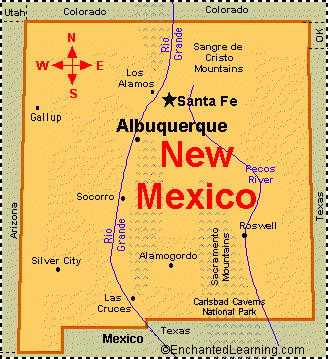
New Mexico's Secretary of State wants to investigate 64,000 voter registrations by cross checking them with the state's Motor Vehicle Division's database. Unfortunately that's not going to work.
Here's what I found most interesting. According to the Brennan Center for Justice at NYU Law,"If the right to vote [in New York City] were conditioned on a proper match, up to 20 percent of new voter registrations would have been rejected solely because of data entry errors. Similar 'matching' error rates of 20-30 percent were discovered in Washington State. And the Social Security Administration has reported a 28.5 percent failed match rate nationwide." Whoa. Having worked with quite a few state voter files I guess that number should not surprise me, but it does highlight how much inaccuracy there is in our well...everything. This is why I reaaaallly think we should have a national voting database to eliminate at least some of the discrepancies that occur by moving from state to state.
The Fair Elections Legal Network wrote Secretary of State Duran objecting to the measure. "We fear that your attempt to ensure 'accuracy and integrity' in the system has had the opposite effect as unsubstantiated claims of large numbers of irregularities on voter registration records do not lead to greater accuracy of records and may, indeed, serve to undermine confidence in the system."
No one has taken legal action but the President of the the FELN implied that could be a next step. In his letter he quoted the following New Mexico state law "It is unlawful for the qualified elector's month and day of birth or any portion of the qualified elector's social security number required on the certificate of registration to be copied, conveyed or used by anyone other than the person registering to vote, either before or after it is filed with the county clerk, and by elections administrators in their official capacity."
It sounds like the FELM is right. The Secretary of State's actions, though possibly well intentioned, would serve no purpose except to undermine confidence and threaten privacy, which would, of course, reduce voter turnout.
Labels:
Election Law,
New Mexico,
registration,
Voter Suppression,
voting rights
Thursday, August 18, 2011
Happy 19th Amendment Day!
Ninety-one years ago today women got the right to vote! Well, I would argue that technically we always had the right but now it's legal. Despite Michelle Bachmann's recent showing in the super- undemocratic Iowa Straw Poll, I think we can agree that overall women's suffrage has been a good thing. Rejoice, my sisters!
You know who didn't think so? Woodrow Wilson. In 1876 he said "Universal suffrage is the foundation of every evil in this country." He later changed his mind when it became politically expedient, but I prefer to remember him as the racist, sexist bigot he was. Here, written by Wilson 1912, is maybe my favorite argument ever as to why women shouldn't vote:
The principal objection to giving women the ballot is that they are too logical. A woman's mind leaps instantly from cause to effect, without any consideration whatever for what lies between. She thinks too directly to be enfranchised en bloc. She would run into all sorts of trouble. For instance, a woman's mind works like this: If she were voting and taking an active part in politics as men do, and if she was desperately anxious to accomplish a particular thing she would ignore every obstacle in her path and try to get it by instant, direct action.
God forbid.
Thursday, June 23, 2011
Tuesday, June 21, 2011
Today in Voter Suppression
An 11-judge panel of the 9th U.S. Circuit Court of Appeals is reconsidering a three-judge panel's ruling that the state's proof of citizenship requirement conflicts with federal voter registration law that law allows people registering to vote to swear under penalty of perjury that they are citizens.
I think my pro-voting/pro-access-to-voting/few-hurdles-to-voting-as-possible credentials are well enough secured, that I can say requiring proof of citizenship to register to vote does not seem like an undue burden.
Sure, we know where Arizona lawmakers' citizenship checking motivations come from and I certainly don't agree with those. But, if you are a person who is intentionally voting somewhere you shouldn't, you probably don't have any qualms about lying about it knowing you are very unlikely to get caught. If we're asking people to swear that they are citizens, they we obviously care about finding out, and if we care about finding out, why not do it right?
On the other hand this type of legislation would disproportionally affect poor people and young people since both groups are transient and less likely to have access to or knowledge of proper documentation. My friend Natalie points out that many domestic violence victims often won't have documentation because they have had to flee their abusers. Nor of course, would homeless people. These are all groups that don't need more barriers.
So I think where I stand is that in a perfect world we should require proof of citizenship to vote, but we also shouldn't be disenfranchising the aforementioned groups. So until we can solve the *shouldn't* by other means the *should* will have to wait.
Subscribe to:
Posts (Atom)